Traders transitioning away from centralized platforms are constantly searching for secure, private, and highly efficient alternatives. The growing demand for decentralized finance (DeFi) has paved the way for innovative exchanges that prioritize user control without sacrificing performance. One platform that has recently gained significant traction in the crypto community is TrueTrade. However, with the rapid emergence of new decentralized exchanges (DEXs), a critical question arises for every careful trader: is the true trade legit?
In this comprehensive review, we will evaluate the legitimacy, security architecture, trading mechanics, and overall reliability of TheTrueTrade. By analyzing its smart contract infrastructure, non-custodial framework, and fee structures, we aim to provide a transparent look at whether this platform is a safe and robust choice for your cryptocurrency trading journey.
Understanding The True Trade: What Is It?
TrueTrade is a next-generation decentralized perpetual exchange built natively on the BNB Chain. It is designed to bridge the gap between the seamless experience of a centralized exchange (CEX) and the complete autonomy of a decentralized application (DApp).
The platform allows users to trade crypto and perpetual contracts with leverage scaling up to an astonishing 1001×. All trades are settled in USDT margin, completely non-custodial, and highly gas-optimized. Every position, trade execution, and price feed is backed by the robust infrastructure of the BNB Chain, powered by Chainlink oracles for accurate pricing, and integrated with TradingView for advanced charting capabilities.
For traders wondering if the platform can handle professional-grade demands, the integration of these industry-standard tools provides a strong foundation of legitimacy.
Is The True Trade Legit? Evaluating Platform Security and Architecture
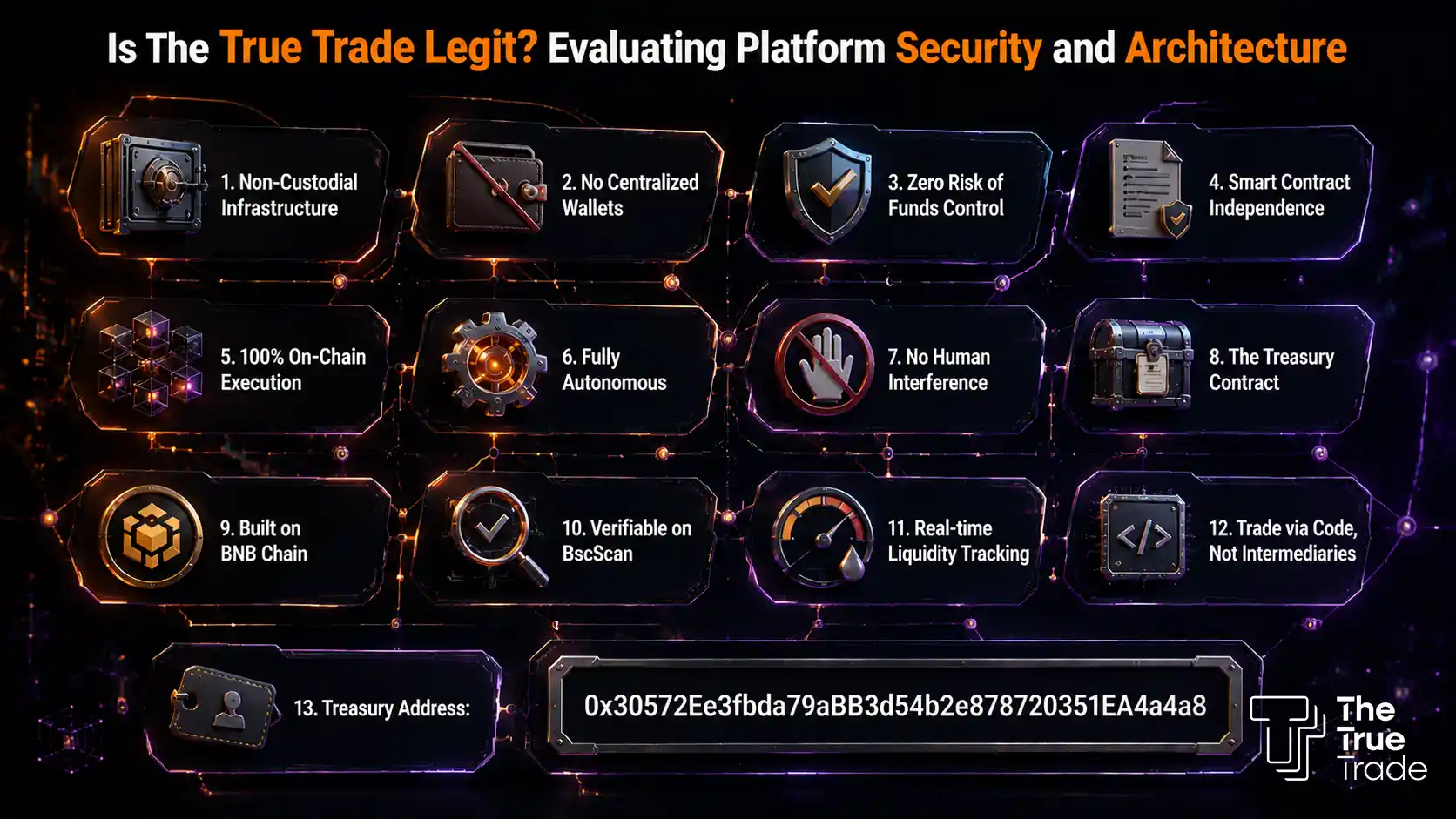
The true test of any decentralized platform’s legitimacy lies in its underlying architecture. Scams and fraudulent exchanges typically require users to deposit funds into a centralized wallet controlled by unknown operators. TrueTrade eliminates this risk entirely through its non-custodial and smart contract-driven infrastructure.
Smart Contract Independence TrueTrade operates entirely through on-chain smart contracts. This ensures transparency, automation, and trustless execution across all trading activities. These contracts manage the platform’s core functions autonomously—from position handling and settlement logic to collateral management—without any centralized control or human interference.
The Treasury Contract All user interactions, deposits, and withdrawals are executed securely through the platform’s main treasury contract on the BNB Chain: 0x30572Ee3fbda79aBB3d54b2e878720351EA4a4a8. Every deposit, withdrawal, and trade can be independently verified on BscScan. This level of transparency is a massive indicator of legitimacy, as users can track the exact flow of funds and verify the liquidity of the platform in real-time. You trade through verifiable code, not hidden intermediaries.
The KYC-Free and Non-Custodial Framework
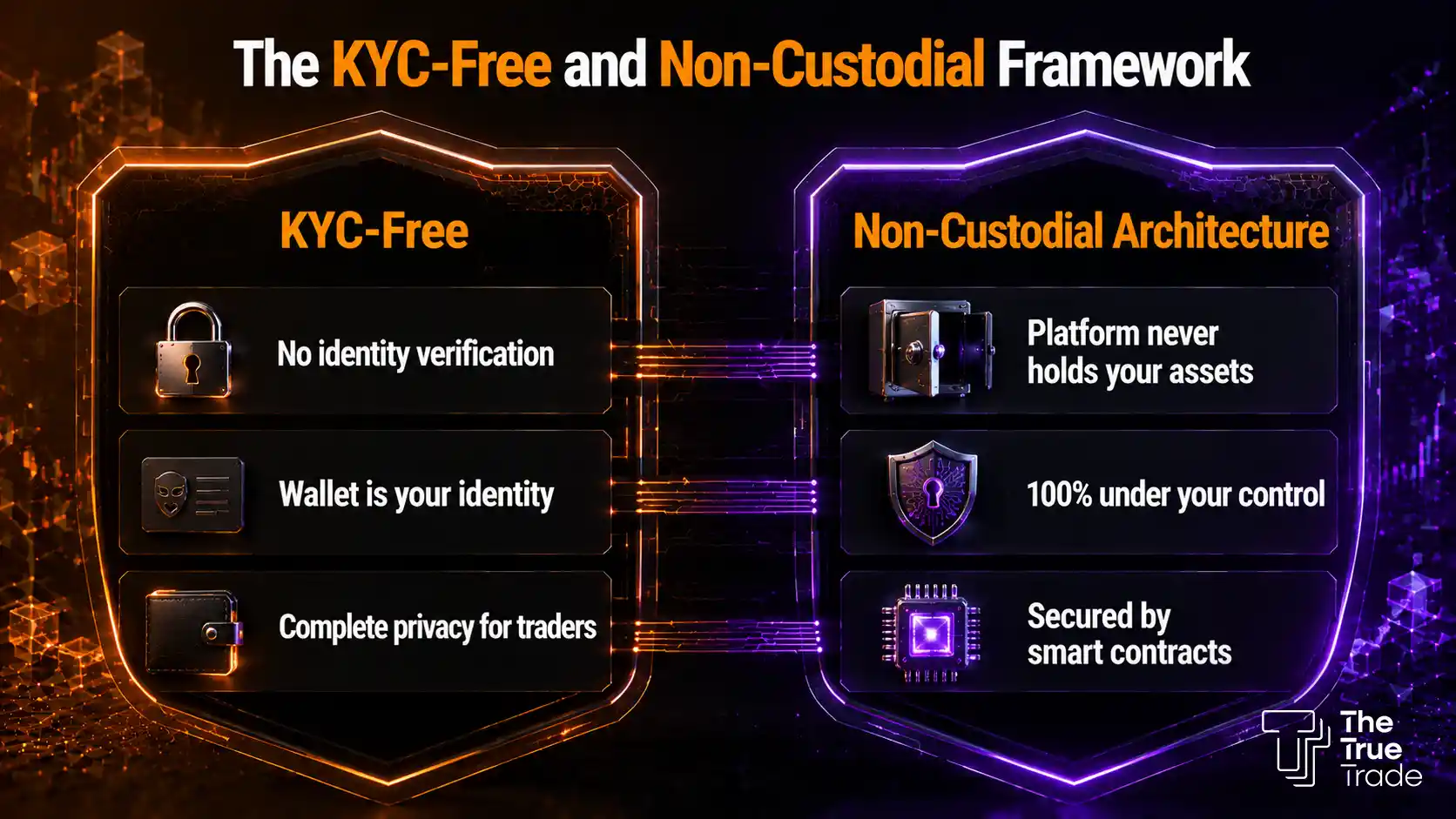
One of the most appealing features of TrueTrade for global traders is its commitment to privacy. TrueTrade is a fully KYC-free and non-custodial perpetual exchange.
Why KYC-Free Matters In the true spirit of decentralized finance, no identity verification or personal data submission is required to trade on TrueTrade. You simply connect your Web3 wallet or sign up with an email, and your wallet acts as your unique identity. For traders who value privacy and wish to avoid the invasive data collection practices of centralized exchanges, this is a major advantage.
Non-Custodial Architecture TrueTrade never holds your assets. Unlike traditional exchanges where your funds sit in a corporate wallet, your assets on TrueTrade remain entirely under your control. The smart contracts handle the logic, giving you full custody. This non-custodial nature directly answers the question, “is the true trade legit?” because the platform mathematically cannot misappropriate your funds; your assets stay in your wallet until a trade is executed.
Web3 Mode vs. Gasless Mode: Tailored Trading Experiences
To accommodate both DeFi purists and users accustomed to standard exchange interfaces, TrueTrade offers two distinct trading modes: Web3 Mode and Gasless Mode.
Web3 Mode (Non-Custodial)
In Web3 Mode, you trade directly from your own decentralized wallet (such as MetaMask, Trust Wallet, or SafePal). All actions happen instantly on-chain through TrueTrade’s smart contracts. You maintain 100% custody at all times, and you only pay the standard BNB network gas fees for blockchain interactions. This mode is the ultimate expression of trustless trading.
Gasless Mode (Custodial Hybrid)
For users who find gas fees and continuous wallet signatures cumbersome, Gasless Mode offers a frictionless alternative. In this mode, you deposit your USDT into your TrueTrade account balance, and trades are processed internally with zero gas fees. This mimics the lightning-fast, simple experience of a traditional CEX while still operating within the platform’s secure ecosystem. Withdrawals from Gasless Mode require a minimum of 20 USDT and are processed seamlessly by the platform.
Feature Comparison
| Feature | Web3 Mode | Gasless Mode |
| Custody | 100% Non-Custodial (Your Wallet) | Account Balance (TrueTrade managed) |
| Transaction Fees | BNB Gas Fees apply per on-chain action | Zero Gas Fees for trading |
| Execution Speed | Depends on BNB Chain confirmation | Instant internal execution |
| Best For | DeFi purists & advanced self-custody | High-frequency & traditional CEX traders |
Users can easily transfer funds between Web3 and Gasless modes directly from their account dashboard, ensuring maximum flexibility.
Trading Interface: Simple Mode vs. Pro Mode
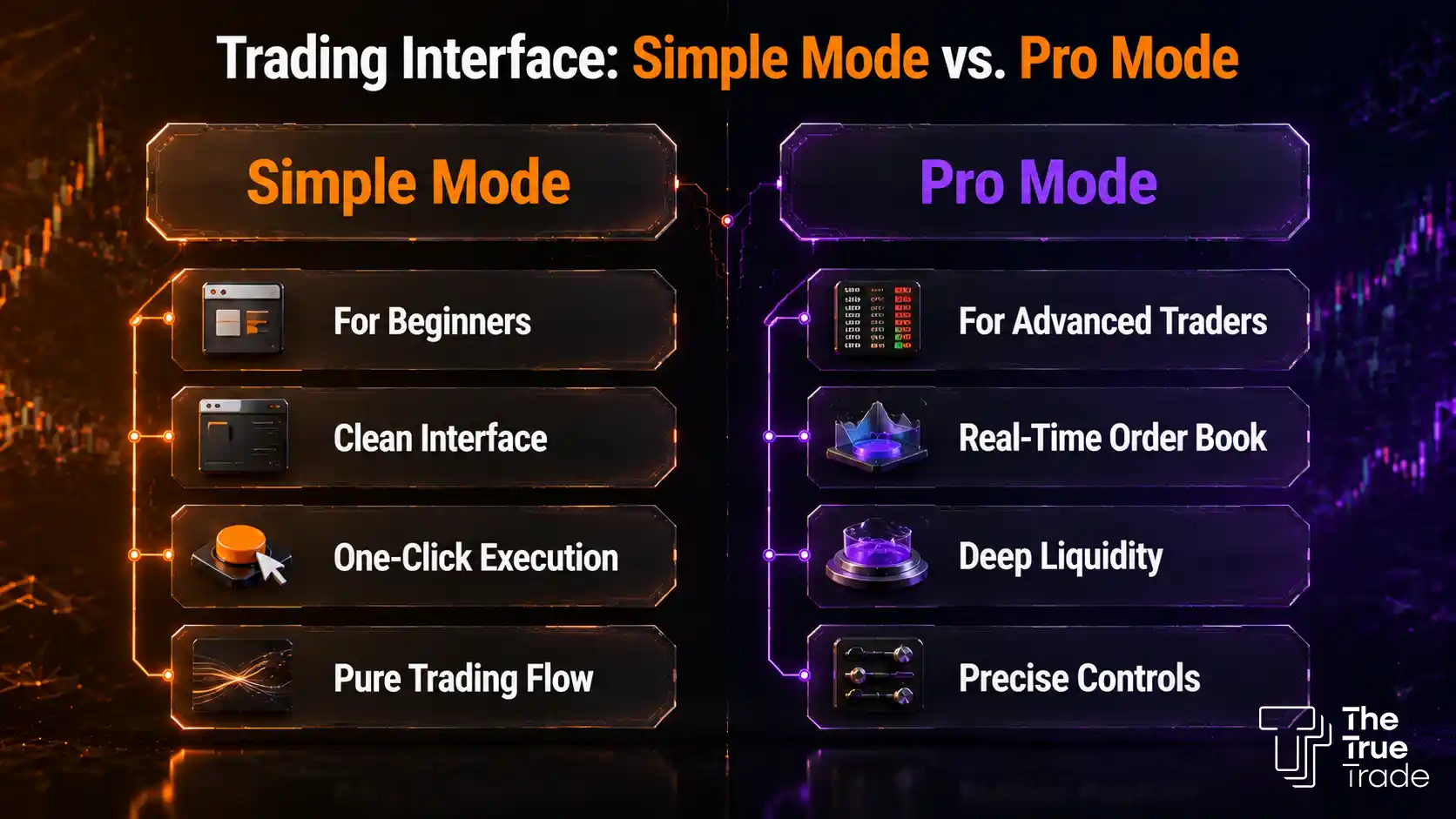
Catering to a diverse user base, TrueTrade provides two tailored trading interfaces.
Simple Mode is engineered for effortless, intuitive trading. With a clean, clutter-free interface and one-click execution, it is ideal for beginners or traders who want to open and close positions rapidly without distractions. It focuses entirely on pure trading flow.
Pro Mode is built for advanced traders. It unlocks the full depth of the perpetual trading engine, featuring a real-time order book, deep liquidity access, and precise execution controls. Whether you are scalping the market or managing complex risk profiles, Pro Mode delivers the speed and data necessary for high-level on-chain moves.
Fee Structure and High Leverage Capabilities
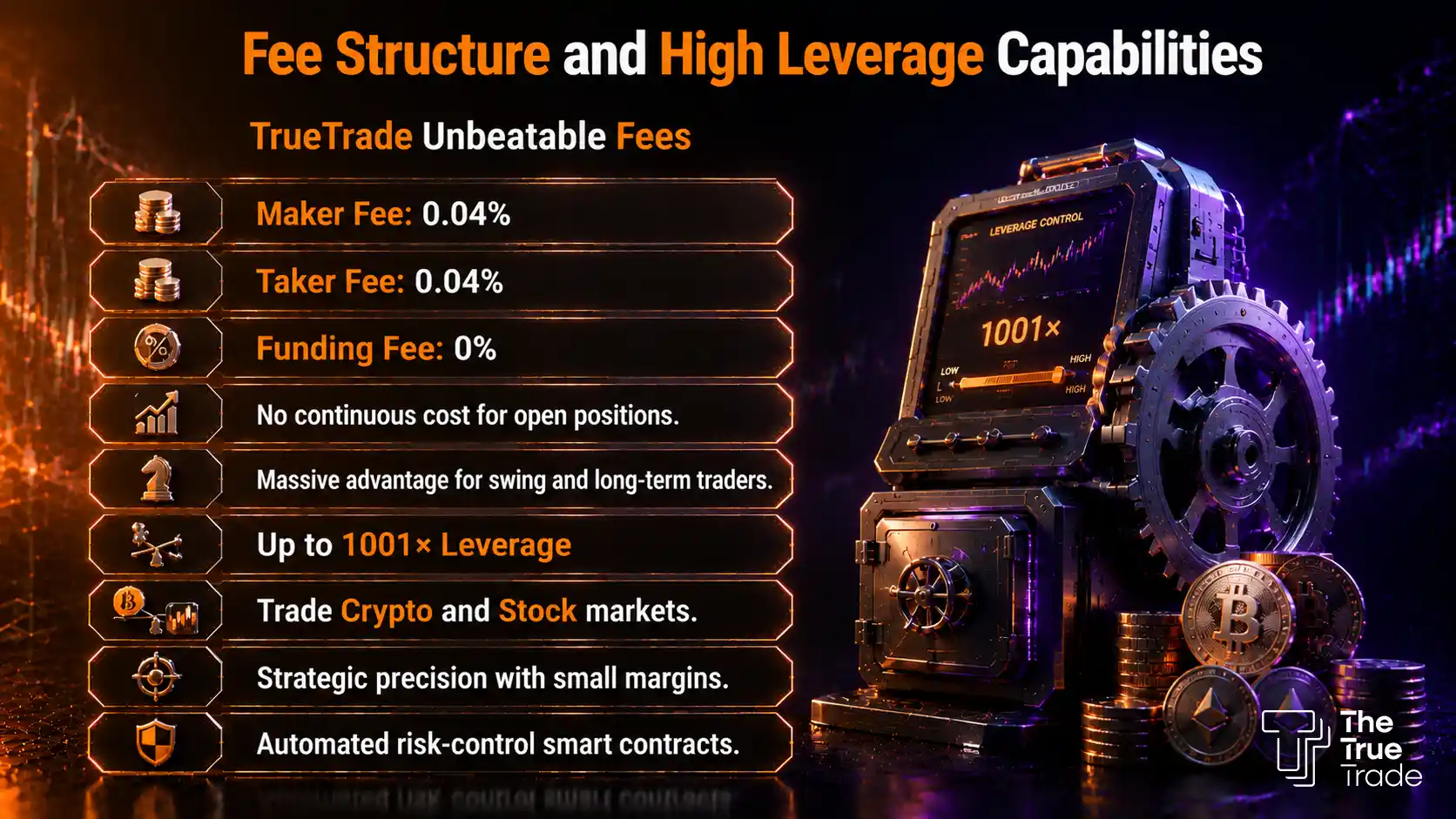
Trading fees and leverage options are critical factors when evaluating a DEX. TrueTrade stands out significantly in this department.
Unbeatable Fee Structure
TrueTrade offers highly competitive rates that minimize the cost of executing large volumes:
- Maker Fee: 0.04%
- Taker Fee: 0.04%
- Funding Fee: 0%
The absolute standout here is the 0% Funding Fee. On most traditional perpetual exchanges, holding a position open for an extended period incurs continuous funding fees, which can quickly eat into profits. By eliminating funding fees, TrueTrade provides a massive structural advantage for swing traders and long-term position holders.
Up to 1001× Leverage
TrueTrade allows users to trade crypto and stock markets with up to 1001× leverage. While ultra-high leverage carries substantial risk, it also provides strategic precision for professional traders utilizing small margins. This feature is backed by robust, automated risk-control protocols within the smart contracts to ensure platform stability.
Deposit, Withdrawal, and Risk Control Systems
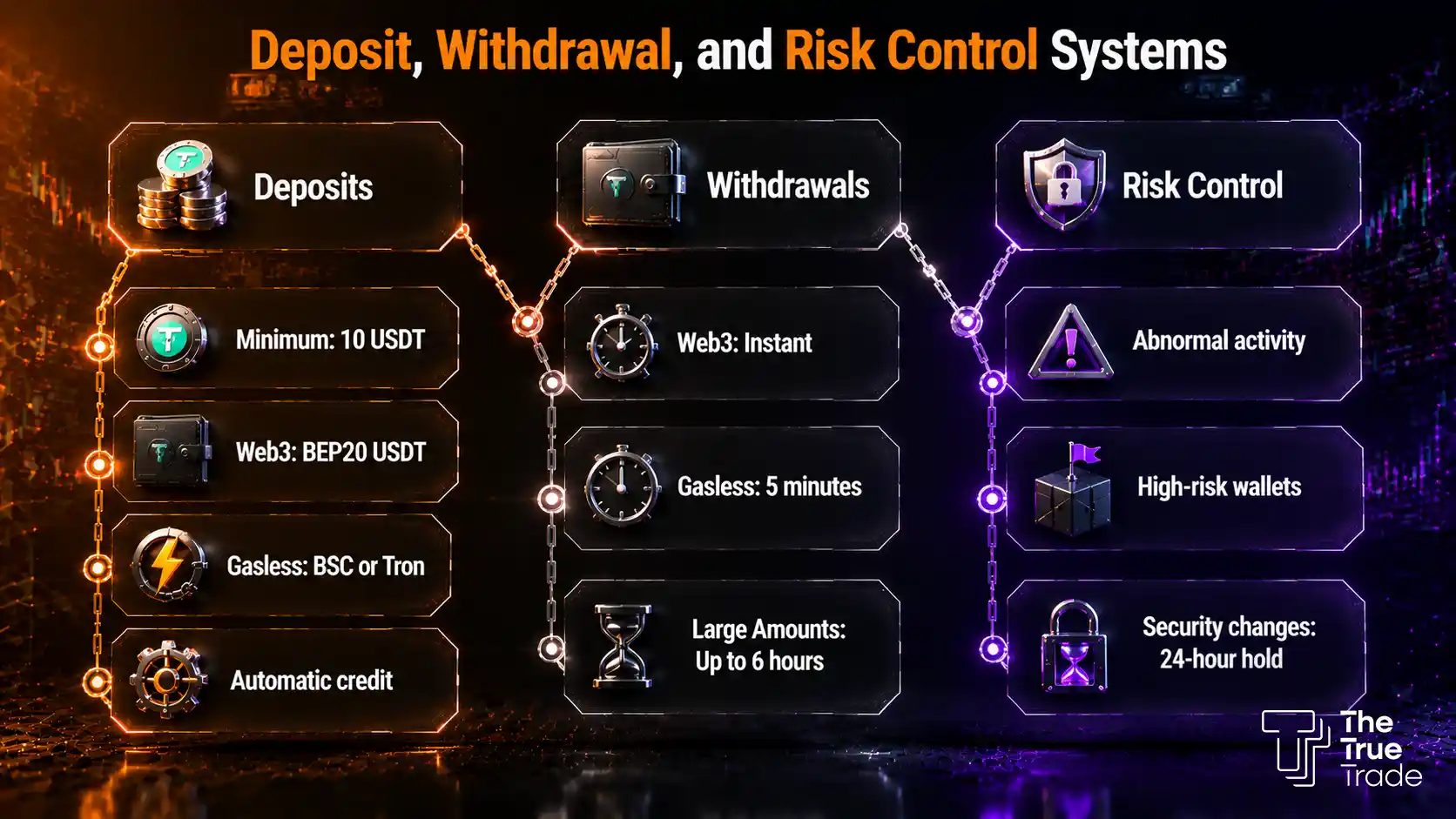
A common concern regarding legitimacy involves how platforms handle withdrawals. TrueTrade operates with full transparency in this area.
Deposits Depositing is straightforward. Web3 users simply interact with the smart contract using their BEP20 USDT. Gasless users can deposit USDT via the BSC (BEP20) or Tron (TRC20) networks. The platform requires a minimum deposit of 10 USDT, and funds are automatically credited upon blockchain confirmation.
Withdrawals and Anti-Fraud Mechanics TrueTrade utilizes an advanced Anti-Fraud and Risk-Control System to protect the platform’s liquidity pool and its users. If a withdrawal is delayed or rejected, it is typically due to standard compliance triggers such as:
- Abnormal activity (e.g., instant withdrawals immediately after massive deposits).
- Use of shared wallets or known high-risk addresses flagged by AML partners.
- Recent security changes (like resetting 2FA or a password), which trigger a temporary 24-hour hold to prevent theft.
These risk-control measures are standard among legitimate financial platforms. Rather than indicating a scam, these thorough automated and manual checks prove that TrueTrade takes security and anti-money laundering protocols seriously. Withdrawals in Web3 mode are executed directly on-chain instantly, while Gasless withdrawals usually take about 5 minutes (or up to 6 hours for large amounts requiring security audits).
Platform Security: Protecting Your Account
While the smart contracts are secure, TrueTrade also provides tools to secure your individual account access.
Users are highly encouraged to enable Two-Factor Authentication (2FA) via Google Authenticator. By binding your email and linking Google 2FA, you ensure that every login, withdrawal, and critical account action requires a localized, time-sensitive code from your mobile device.
Because TrueTrade is a decentralized application, wallet security ultimately falls on the user. The platform explicitly states in its Terms of Use that users are solely responsible for securing their private keys and recovery phrases. The platform cannot recover lost wallet keys, which is the standard reality of legitimate Web3 applications.
Customer Support and Assistance
Legitimate exchanges back their technology with accessible support. TrueTrade provides 24/7 online live support directly through the user profile dashboard. Additionally, users can reach out via email at info@thetruetrade.io for detailed inquiries, feedback, or manual review requests regarding risk-control flags. The presence of a responsive support team adds an essential layer of reliability to the platform.
Final Verdict: Is The True Trade Legit?
So, is the true trade legit? Based on a thorough examination of its architecture, security protocols, and operational transparency, the answer is a definitive yes.
TrueTrade operates on verifiable BNB Chain smart contracts, meaning the code dictates the flow of funds, not a centralized group of executives. Its non-custodial Web3 mode guarantees that traders maintain complete ownership of their assets. Furthermore, features like 0% funding fees, the flexibility between Simple and Pro modes, and stringent risk-control measures demonstrate that the platform is built to sustain long-term, professional trading.
For international traders looking for a KYC-free, transparent, and high-performance decentralized perpetual exchange, TrueTrade presents a highly legitimate and compelling solution. If you are ready to take control of your trades without borders or intermediaries, exploring TrueTrade’s zero-funding fee environment could be your next strategic move.
Frequently Asked Questions (FAQs)
Do I need to verify my identity (KYC) to trade on TrueTrade?
No, TrueTrade is a fully KYC-free platform. You do not need to submit any identity documents, passports, or personal data to start trading. You can connect directly with your Web3 wallet or sign up using an email address, ensuring your privacy remains intact while you trade.
Why was my withdrawal rejected or placed under review?
TrueTrade employs an automated Anti-Fraud and Risk-Control system to protect users. If your withdrawal is rejected or delayed, it is likely due to a security trigger, such as a recent password/2FA change, abnormal deposit/withdrawal patterns, or logging in from a highly unusual IP address. This is a standard security feature to protect your funds, and you can simply contact their 24/7 customer support to resolve the review.
What blockchain networks does TrueTrade support for deposits and withdrawals?
TrueTrade is natively built on the BNB Chain. If you are using Web3 Mode, all transactions and deposits must be conducted using USDT on the BSC (BEP20) network. If you are using Gasless Mode, you can deposit and withdraw USDT using either the BSC (BEP20) or the Tron (TRC20) networks. Always ensure you select the correct network that corresponds to your destination wallet.


